Sarah Knight Eats Her Way Through Connecticut: What Her 1704 Journal Reveals About Colonial Food on the Road

In October 1704, a Boston businesswoman named Sarah Kemble Knight climbed onto a horse and rode south toward New Haven and New York, alone except for hired guides, on a legal errand involving a dead man's estate. Along the way she kept a journal. It wasn’t published until 1825, more than a century after she wrote it, but what survives is one of the most specific and vivid accounts of colonial domestic life we have. A first hand account of the life of ordinary roadside taverns, poor cottages, and the people who kept them.
Knight was sharp-tongued and unsparing. She was also hungry a great deal of the time.
The Woman at the Table
Sarah Kemble was born in Boston in 1666, the daughter of a merchant. She married Richard Knight sometime before 1689, ran a boarding house and shop on Moon Street, worked as a court scrivener copying legal documents, and was, by every account, a woman who managed her own affairs with considerable competence. Whether she was technically a widow when she made the journey in 1704 or a wife whose husband was simply absent and incapacitated is a question the sources do not resolve cleanly. What is clear is that she organized the trip herself, negotiated directly with innkeepers and guides, and paid her own way for five months on the road.
She set out on October 2, 1704, following the Boston Post Road south through Rhode Island, Connecticut, and into New York. The road was rough, unmarked in stretches, and interrupted by rivers requiring either fording or canoe crossing. Guides had to be hired at each stage. Inns varied from merely uncomfortable to the genuinely squalid.
What Was on the Table
The first meal she describes sets the tone for everything that follows. Somewhere in Rhode Island on October 3rd, she asks for something to eat at a tavern and receives what she describes with magnificent disdain: a dish of pork and cabbage, apparently the remains of someone else's dinner, with a sauce "of a deep Purple, wch I tho't was boil'd in her dye Kettle." The bread was Indian, meaning cornmeal. The tablecloth, which the woman of the house struggled to spread, was apparently not designed to be spread at all.
The purple sauce, food historians say, is almost certainly pickled red cabbage, which turns a striking bluish-purple in alkaline cooking water. That combination, salt pork and pickled cabbage, was a standard colonial preservation pairing, the kind of meal that kept through the week without refrigeration and appeared on tavern tables whenever a traveler arrived unannounced. Knight ate a little of it and suffered for the rest of the day.
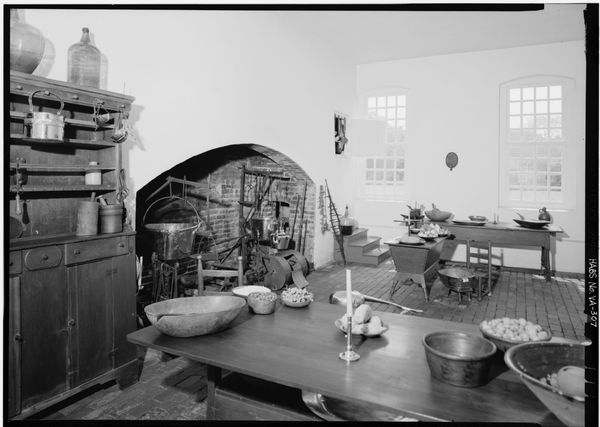
Later that same night she received better treatment at a Mr. Havens' lodging in the Narragansett country. She had brought her own chocolate, a luxury item in 1704, and asked the good woman of the house to prepare it. The hostess did so with what Knight specifically noted was "a little clean brass Kettle" and some milk. The emphasis on clean is pointed. Knight would not have praised cleanliness unless she has recently seen its absence.
The brass kettle is worth pausing on. Brass and copper vessels were the standard colonial equipment for heating liquids, appearing consistently in probate inventories of the period alongside iron pots and pewter dishes. That this tavern had one, clean and ready, marked it as a reasonably equipped household.
What She Refused to Eat
Knight's most vivid food passages are often the ones where she declines to eat at all. At a tavern two miles past the Stratford ferry in Connecticut, she and her companion encountered "Pumpkin and Indian mixt Bred" that apparently looked so uninviting they paid and left without eating. The drink on offer was something called "Bare-legg'd Punch," a phrase that has puzzled scholars ever since, possibly a rum punch served raw without sugar or fruit garnish.
At a French-kept ordinary in Rye, New York, she asked for a fricassee, a braised meat dish she evidently considered a reasonable request of a French cook, and went to bed without supper when the result failed to meet her expectations. She does not say what went wrong. She simply notes she hastened to bed "superless."
These refusals tell us as much as the meals she ate. The pumpkin and cornmeal bread was a real food, widely documented in colonial Connecticut as a practical combination of two abundant local ingredients. That Knight found it visually repellent says something about the gap between the Boston table she knew and what the road offered. The fricassee expectation says something else: travelers arriving at colonial ordinaries could and did request specific preparations rather than simply accepting what was set before them.
A Kitchen Shelf in Norwalk
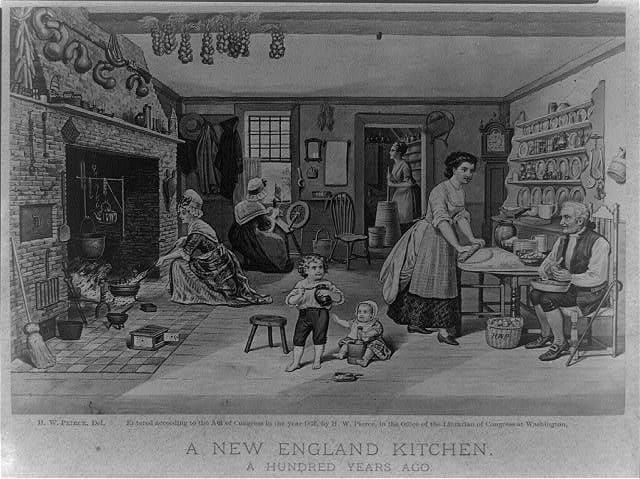
The briefest of Knight's food passages is also one of the most charming. At noon dinner in Norwalk on the leg between New Haven and New York, she is served fried venison. The landlady, finding she needs pepper, calls to a girl to fetch it: "the spice in the little Gay cupp on ye shelfe."
A small decorated cup on a kitchen shelf. A landlady directing a girl. Pepper used to season venison. In these three sentences we can see a scene of practical domestic life, preserved because one opinionated traveler happened to be watching.
The Cottage by the Paukataug River
The single most striking domestic inventory in Knight's journal comes not from a tavern but from a poor cottage where she waited for floodwaters to fall near the Paukataug River on October 4th. She describes it with the precision of a woman who has seen real poverty and wants her reader to understand it:
An earth floor. A door tied on with cord where hinges should be. No proper windows. A bed with a glass bottle hanging at the head, probably serving as a candle holder. One earthenware cup. A pewter basin. A board set on sticks instead of a table. Blocks instead of chairs.
Knight notes, with what seems like genuine respect, that "both the Hutt and its Inhabitance were very clean and tydee." The household had almost nothing, and what it had was maintained with care.
This cottage, cross-referenced against probate inventories from rural New England of the same period, represents what material poverty looked like in colonial Connecticut. The pewter basin is significant: even this household owned at least one piece of pewter, the most basic indicator of domestic respectability in the colonial material record.
The Molasses That Ended Badly
On the return journey in late December, caught in a snowstorm near Eastchester, Knight was forced to stop at a poor house and ask for something warm to drink. The household had only milk and molasses. They boiled the milk and sweetened it with molasses, which Knight drank without knowing what was in it, and which promptly came back up "in so plentiful a manner that my host was soon paid double for his portion."
Milk and molasses: two genuine colonial pantry staples. Molasses was a byproduct of sugar refining imported from the West Indies, widely available and cheap enough for poor households to keep. Warm sweetened milk was a real remedy for cold and illness. Knight's reaction was simply bad luck.
What the Journal Is, and What It Is Not
One thing worth knowing about this document before you follow the links below: the original manuscript has been lost since at least the 1850s, and the text we have comes entirely from a transcription made by Connecticut writer Theodore Dwight in 1825, more than a century after Knight wrote it. The scholarly consensus accepts the journal as genuine, supported by cross-checking of dates, places, and people mentioned. But a small authenticity debate persists, and the journal should be read with that in mind.
What it is not is an objective record. Knight was a Boston gentlewoman traveling among people she considered her social inferiors, and her account reflects that position on every page. Her descriptions of rural Connecticut people, her observations about enslaved workers eating at the same table as their enslavers, her dismissal of Indigenous people: all of it is filtered through a particular class and cultural lens. Reading the journal historically means reading it critically.
What it is, even accounting for all of that, is irreplaceable. No other source from this period puts you inside a colonial roadside kitchen with the same specificity. The purple sauce, the little gay pepper cup, the board on sticks: these details survive because one difficult, funny, observant woman wrote them down and someone preserved what she wrote.
The full text is freely available at the Early Americas Digital Archive at eada.lib.umd.edu, and the 1865 print edition has been scanned and is searchable at archive.org. Also, Alice Morse Earle's Home Life in Colonial Days covers this same period and type of source in depth
Curious about the material world of colonial American homes? The Colonial Hearth Letter arrives every week with one new discovery from the archive: a period recipe, a household object, a primary source find. Subscribe free at americancolonialhome.com